
The preventive archaeology fee (RAP) weighs heavily on the budgets of many construction and development projects, sometimes unexpectedly. Since the decision (EU) 2026/1875 by the European Commission, the RAP is confirmed as a tax contributing to the general budget of the State, rather than direct funding for INRAP. This change in classification opens up avenues for tax disputes that most developers underutilize.
Challenging the RAP on fiscal grounds: means strengthened since 2026
The reclassification of the RAP as a common tax by the European Commission alters the litigation strategy. The argument based on state aid is now weakened. On the other hand, traditional appeals against taxes gain relevance: errors on the taxable base, procedural defects, errors in qualifying the triggering event.
We recommend systematically checking three elements before accepting the notified amount:
- Does the taxable area determined correspond exactly to the actual footprint of the work affecting the subsoil, or has the administration included areas without underground impact?
- Is the triggering event correctly identified? The RAP only applies to operations subject to urban planning authorization and having an impact on the subsoil. A project that does not affect the subsoil falls solely under the development tax.
- Does the notification comply with the deadlines and formats set by the Heritage Code? A procedural defect can lead to total exemption from the fee.
Several project owners who are aware of the tips for the preventive archaeology fee achieve significant reductions by contesting the area determined, especially when the project involves both excavated and non-excavated zones.
Advance request for archaeological prescription: reducing financial risk upstream
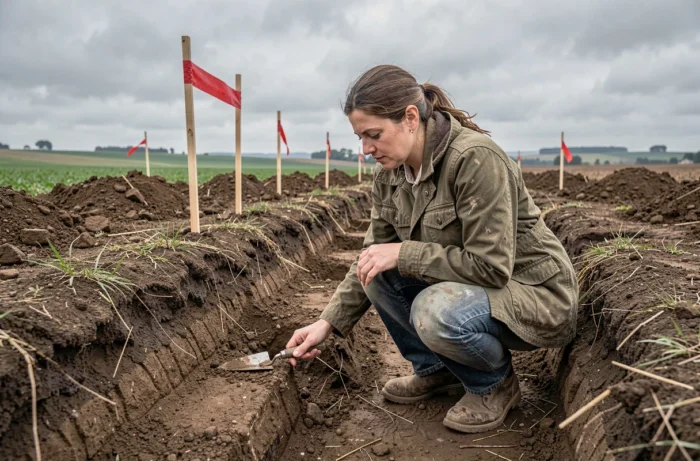
Waiting for the building permit to discover that an archaeological diagnosis is required remains the most costly mistake in terms of delays. The advance request for prescription allows one to approach the regional prefect before submitting the urban planning authorization, to find out if the land is likely to be subject to a prescription.
This approach is not just a simple information tool. It triggers a review of the file by the Regional Archaeology Service (SRA), which has a set timeframe to respond. In the absence of a response within this timeframe, the developer benefits from a presumption of absence of prescription.
The strategic interest is twofold. First, it allows for calibrating the project’s budget by including or excluding the cost of diagnosis and potential excavations. Second, it offers the possibility to modify the project’s scope before submitting the permit.
Modifying the project’s scope to avoid prescription
If the advance request reveals a high archaeological sensitivity, we observe that some developers revise their project to limit the ground footprint or the depth of excavation. Reducing the area affecting the subsoil mechanically decreases the base of the RAP and may even push the project below the threshold triggering a diagnostic prescription.
This approach requires technical dialogue between the architect, the geotechnical study office, and the SRA. It works particularly well for extensions of existing buildings, where the choice between deep foundations and shallow foundations directly alters exposure to the RAP.
Legal exemptions from the RAP: lesser-known cases for developers
The Heritage Code and the Urban Planning Code provide several cases of exemption that project holders neglect due to lack of precise knowledge. The exemption does not apply automatically: it must be invoked at the time of submitting the authorization or within the framework of a contentious claim.
- Buildings dedicated to a public service or public utility (health, education, culture, sports) are exempt, provided they maintain this designation for at least five years.
- Residential premises financed by a supported rental integration loan (PLAI) are exempt from the RAP.
- Agricultural premises, including production greenhouses and animal housing buildings, benefit from a specific exemption.
The classic trap concerns mixed projects. When a real estate program combines PLAI housing and free housing, only the PLAI portion is exempt. We recommend accurately breaking down the areas in the permit file to avoid a flat-rate taxation on the whole.

Negotiating excavation costs: the most underestimated lever
The RAP funds the diagnosis, but it is the cost of excavations that represents the heaviest burden for a developer. Since the opening to competition, approved excavation operators can be put in competition by the project owner. This option remains underutilized, even though it can generate considerable price differences from one operator to another.
The scientific specifications are set by the SRA, but the operational modalities (scheduling, technical means, site organization) are subject to contractual negotiation. An experienced developer integrates the excavation into the overall project schedule to avoid additional costs related to site immobilization.
Coverage by local authorities and public developers
Local authorities can cover all or part of the excavation costs as part of public development operations (ZAC, municipal subdivisions). This funding often comes through the budget of the development operation, without the final buyers directly bearing the burden. For private developers involved in mixed operations, the public equipment participation agreement can include a clause for sharing the archaeological cost.
The RAP remains an unavoidable component of the construction budget as soon as the subsoil is involved. There are maneuvering margins, but they play out upstream of the project: verification of the base, advance request, technical choices limiting underground footprint, and tax appeals based on the now strictly fiscal nature of this tax.