
Palliative care does not follow a linear path that is the same from one patient to another. The end-of-life trajectory depends on the illness, the overall condition of the person, and the response to comfort treatments. Understanding what happens physically and psychologically over the weeks allows loved ones to better support the patient without being overwhelmed by the unexpected.
Changes in consciousness and sleep in the pre-terminal phase
Even before the actual terminal phase, the body sends subtle signals that those around may sometimes misinterpret. Progressive weakness is the symptom that most troubles patients, more than pain itself when it is managed by the medical team.
The sleep-wake cycle often changes significantly. The patient sleeps more during the day and remains awake at night, sometimes restless or anxious. This reversal of the circadian rhythm does not necessarily indicate a sudden deterioration: it reflects general metabolic exhaustion.
Appetite gradually decreases. The person may refuse meals they enjoyed a few weeks earlier. This withdrawal from food worries loved ones, but forcing nutrition at this stage does not improve comfort or prognosis. The palliative care team adjusts care so that hydration and nutrition remain proportionate to the patient’s actual needs.
Describing the different stages of end of life helps to identify these changes without dramatizing or minimizing them.
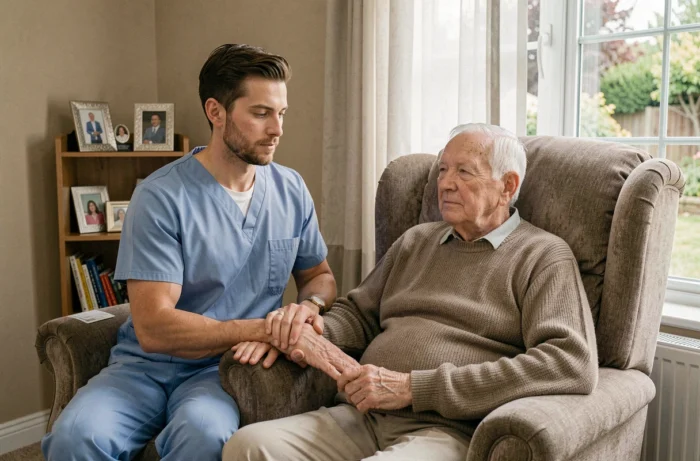
Physical signs of the terminal phase: what the body expresses
When life expectancy is measured in days, several physiological changes become visible. Knowing them allows loved ones to remain present without panicking in the face of manifestations that are part of the natural dying process.
- Irregular breathing: breathing pauses (apneas) alternate with phases of rapid breathing. Bronchial congestion may produce a raspy sound, sometimes called “agonal breathing,” which is generally not painful for the patient.
- Mottled skin and cold extremities: blood circulation concentrates on vital organs. Hands, feet, and knees may take on a bluish or mottled hue.
- Decreased or stopped urination: the kidneys slow down their activity. Urine becomes darker and less abundant, until it stops completely.
- Profound alteration of consciousness: the patient may no longer respond to verbal stimuli while still perceiving touch or the voice of loved ones. Hearing is considered the last sense to fade.
These signs do not all occur simultaneously. Their timeline varies from one patient to another, and the care team reassesses comfort daily to adjust pain relief or anxiolytic treatments.
Palliative care and deep sedation: medical framework and decision
French law regulates end-of-life care through several successive texts. The right to access palliative care has been recognized since the law of June 9, 1999, which establishes the principle of equal and universal access. The Claeys-Leonetti law of 2016 introduced the right to deep and continuous sedation until death in specific situations.
Conditions for access to deep sedation
Deep and continuous sedation is not a decision taken lightly. It concerns patients with a serious and incurable condition whose life prognosis is at risk in the short term, and who experience suffering that is refractory to other treatments. The physician implements this sedation after a collegial procedure involving the care team and, whenever possible, the patient or their trusted person.
Advance directives play a crucial role. If the patient has drafted these directives, they are binding on the physician unless there is a vital emergency or they appear manifestly inappropriate. In the absence of advance directives, the designated trusted person is consulted first.
What sedation changes for loved ones
Once deep sedation is initiated, the patient loses consciousness irreversibly. Loved ones can remain present, talk, and hold the patient’s hand. Support does not stop with the loss of consciousness. Palliative care teams continue to monitor signs of discomfort and adjust doses.
Feedback from families during this period varies. Some loved ones describe a visible calming of the patient, while others express a feeling of helplessness in the absence of response. The psychological support offered by the team also addresses the family, before and after death.

Role of advance directives and the trusted person
Any adult can draft advance directives to express their wishes regarding their end of life. This document, which can be revised at any time, specifies the treatments that the patient wishes or refuses if they are no longer able to express themselves one day.
The designation of a trusted person complements this system. This relative or member of the medical team will be consulted by the physician when the patient can no longer communicate. Their testimony takes precedence over that of other family members in the decision-making process.
The available data do not allow for a conclusion on the actual rate of drafting advance directives in France, but healthcare professionals observe that the majority of patients admitted to palliative care units do not have them at the time of admission. This gap complicates care and prolongs collegial discussions, in an already emotionally challenging context for loved ones.
Drafting advance directives does not require a specific form. A dated and signed document is sufficient, provided it is accessible in the patient’s medical file. The attending physician and the palliative care team can assist with this process in advance, well before the terminal phase is reached.