
Your pumice stone has lost its original color, emits an unpleasant odor, or seems less effective on calluses. This is not a quality issue: it’s a maintenance issue. This porous volcanic rock accumulates dead skin cells, moisture, and bacteria in its micro-cavities after each use. Properly cleaning your pumice stone extends its lifespan and protects the skin on your feet.
Why a dirty pumice stone can cause skin infections
The porous structure that makes pumice effective for exfoliating skin is also what turns it into a microbial reservoir. Debris from dead skin gets lodged in the holes and grooves. In a humid environment, these organic residues become a breeding ground for mold and bacteria.
Have you ever noticed an unpleasant odor when bringing your pumice stone close to your nose? This is a sign of active bacterial colonization. Using a stone in this state on cracked feet or small wounds exposes you to fungal infections or minor infections.
Complete drying after each use is as crucial as the cleaning itself. Leaving the stone in a humid environment (bathtub edge, shower floor) maintains the cycle of proliferation. Store it in a dry, well-ventilated place, never in a closed bag or a damp drawer.
In fact, by applying these tips for cleaning pumice stones regularly, you can avoid having to replace it too quickly.
Daily cleaning of the pumice stone after each use
The simplest gesture is also the most neglected. After each use on your feet, rinse the stone under warm running water. Scrub it with an old toothbrush to dislodge the skin particles stuck in the pores.
This mechanical scrubbing makes all the difference. A simple rinse is not enough to extract the residues lodged deep in the rock. The toothbrush reaches the cavities that water alone cannot clean.
Then let the stone air dry, placed on a clean surface. Allow several hours for complete drying, more if your bathroom lacks ventilation. The goal: no residual moisture before the next use.
Deep disinfection with baking soda or vinegar
Daily brushing maintains the stone day to day. Deep disinfection, on the other hand, eliminates established bacteria and restores the original porosity. Plan for this thorough cleaning once a week if you use your pumice stone regularly.
Baking soda method
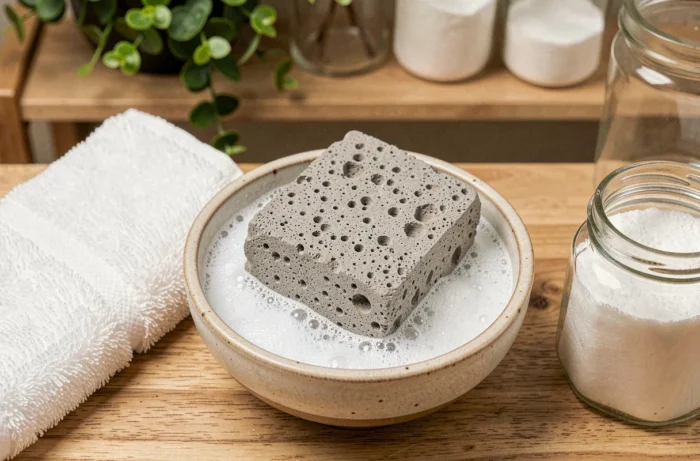
Fill a bowl with hot water and add a few tablespoons of baking soda. Soak the pumice stone in this mixture for about fifteen minutes. The baking soda dissolves the organic residues trapped in the pores while neutralizing bad odors.
After soaking, brush the stone again with a stiff-bristled brush, then rinse thoroughly with clear water.
White vinegar method
White vinegar is an effective alternative, especially when limescale deposits have formed on the stone. Soak the pumice stone in a mixture of equal parts hot water and white vinegar. The vinegar removes limescale and disinfects simultaneously.
The soaking time is the same. Brush, rinse, dry. The two methods can alternate from week to week according to your needs.
What to avoid
- Aggressive chemical cleaning products (like concentrated bleach), which can degrade the porous structure of the rock and irritate the skin during the next use
- Putting it in the dishwasher or microwave, sometimes suggested on forums, which risks weakening or cracking the stone
- Drying with a hairdryer, which creates surface drying without removing internal moisture from the pores
Knowing when to replace your worn pumice stone
Even well-maintained, a pumice stone does not last indefinitely. Two signals should alert you.
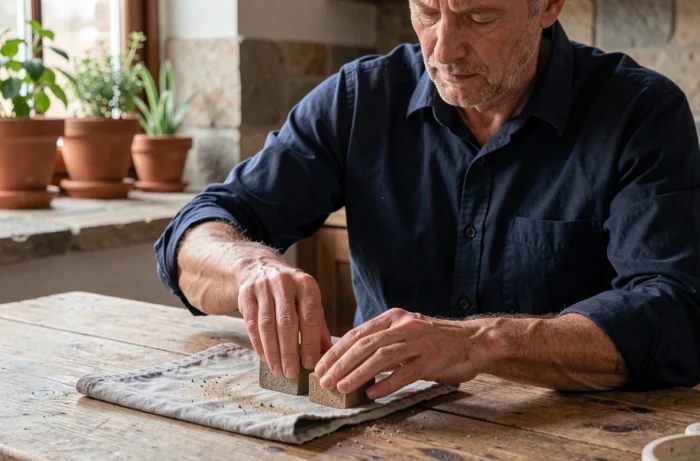
The first is physical: a stone that crumbles, cracks, or loses pieces has exceeded its useful lifespan. Cracks create new cavities that cannot be properly cleaned, where bacteria accumulate out of reach of the brush.
The second is functional: if the surface has become smooth and the stone glides over the skin without exfoliating, its pores are saturated or eroded. No cleaning will restore its original abrasive power.
Another often overlooked point: a pumice stone should not be shared among household members. The dead skin cells and microorganisms of each person are different. Using the same stone for the whole family is like sharing a toothbrush. Each user should have their own clearly identified stone.
Natural or synthetic pumice stone: impact on maintenance
Natural pumice stones, made from volcanic rock, have irregular and deep pores. This complex network makes them more effective for exfoliation but also more difficult to clean thoroughly. Brushing must be meticulous, and the drying time is longer.
Synthetic stones have more regular pores and a more uniform surface. They dry faster and are easier to clean. However, they generally wear out more quickly and can become smooth after a few weeks of intensive use.
- Natural stone: more demanding maintenance, longer lifespan if well cleaned, better exfoliation
- Synthetic stone: simplified maintenance, more frequent replacement, sometimes less gentle abrasion on sensitive skin
- In both cases, the cleaning protocol remains the same: brushing, soaking, complete drying
The choice between natural and synthetic depends on your regularity of maintenance. If you know you won’t brush your stone after every shower, a synthetic stone will be more forgiving of forgetfulness due to its less deep pores. If you follow the cleaning protocol without fail, the natural stone remains the best tool for your feet.
A clean and dry pumice stone protects your feet just as well as a new stone. The real criterion is not the price or the brand, but the rigor of cleaning after each use on the skin.