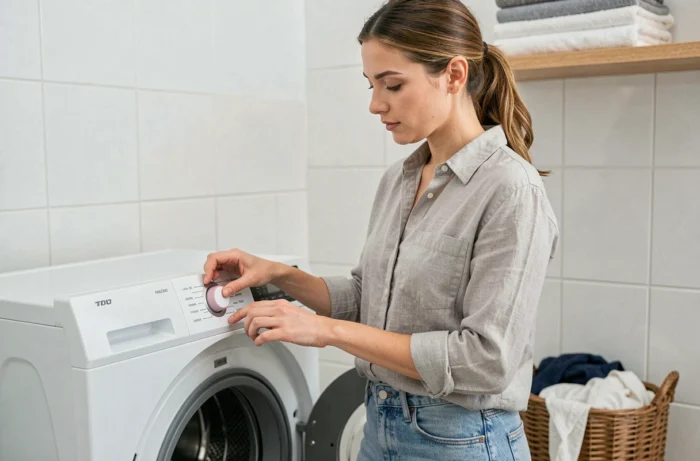
On a Valberg washing machine, the spin symbol identifies the stage when the drum rotates at high speed to extract water from the laundry. This symbol, often a spiral or a stylized representation of a rotating drum, varies from one model to another. Identifying it correctly on the control panel lets you adjust the spin speed or select a dedicated cycle—two settings that directly affect how much moisture remains in the laundry at the end of the program.
Valberg spin cycle: why the symbol alone isn’t enough to choose the right setting
On Valberg washing machines, the spin symbol identifies the function but doesn’t indicate the speed used. Two models may display a similar symbol while offering very different speed ranges.
The reason is simple: each Valberg model has its own control panel. A model such as the WF 712 D W180C has a “Spin” program (with manually adjustable speed) and a “Rinse + Spin” program. Other models don’t offer an independent spin cycle at all. The symbol is therefore a starting point, not a complete guide.
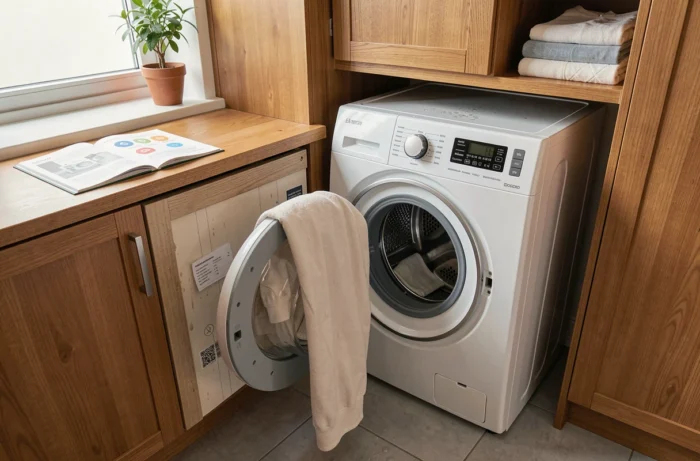
Before interpreting the Valberg spin symbol on your appliance, check the washing machine’s full model number. It can be found on the label inside the door, along the edge of the door opening, or on the back of the appliance. Copy the entire alphanumeric code, then compare it with the corresponding manual. A shortcut or an approximate match may lead you to a model with a different control panel and therefore different programs.
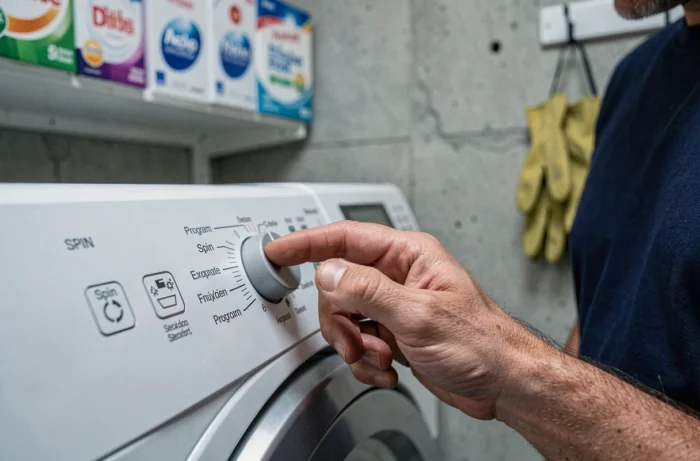
Spin speed on a Valberg washing machine: match the RPM to the fabric type
Spin speed is measured in revolutions per minute. The faster the drum spins, the more water it extracts and the drier the laundry comes out. Depending on the Valberg model, you can usually adjust the speed with a rotary dial or a dedicated button.
Not all fabrics can withstand the same spin speed. Spinning delicate fabric too fast can distort the fibers, while spinning thick cotton too slowly leaves the laundry soaked and significantly increases drying time.
Guidelines by fabric type
- Cotton and linen can withstand the highest speeds offered by the machine. These fabrics benefit most from a high-speed spin, which reduces drying time.
- Synthetics require a medium spin speed. Spinning them too fast can cause permanent creases that are difficult to iron out.
- Wool and delicate fabrics need the lowest speed, or no spin at all. On most Valberg models, the “Delicate” or “Wool” program automatically reduces the spin speed.
The selected program often determines the maximum permitted spin speed. You can select “Cotton 60 °C” and then manually lower the spin speed. However, you can’t exceed the program’s preset limit: the machine automatically restricts the spin speed to protect the laundry and the drum.
Laundry still wet after a Valberg spin cycle: what to check before running another cycle
Laundry that comes out of the machine still wet doesn’t necessarily mean you selected the wrong spin program. Several mechanical or loading issues can explain the result.
Unbalanced load and automatic safety feature
Some Valberg models reduce or even stop the spin cycle when they detect an unbalanced load in the drum. A single heavy item, such as a duvet or thick pair of jeans, can trigger this safety feature. Distributing the laundry evenly and running a spin-only cycle (if your model offers one) resolves the issue in most cases.
Blocked drain filter
The spin cycle can’t work properly if the machine hasn’t drained completely. The WF 712 D manual recommends cleaning the drain filter at least two to three times a year. A clogged filter prevents water from draining, which can stop or slow down the spin cycle. Before suspecting a program fault, unscrew the filter (located at the bottom right on most Valberg models), remove any accumulated debris, and check that water drains freely.
Spin efficiency class: what the energy label tells you about your Valberg
The maximum spin speed, shown in revolutions per minute, provides only a partial indication. The European energy label assigns each washing machine a spin efficiency class, separate from its overall energy efficiency class. This letter (from A to G) measures how much moisture remains in the laundry after spinning: the closer the rating is to A, the less water the laundry retains.
This has a direct impact on running costs. Laundry that has been spun more effectively needs less time in the tumble dryer (or on the drying rack), reducing the electricity used for drying. Two machines with the same maximum spin speed may have different spin efficiency classes, depending on the drum design and how the spin cycle is controlled.
To find your Valberg model’s spin efficiency class, check the product page or the energy label attached to the appliance when you bought it. This information is also included in the technical manual, in the section covering regulatory data.
Spin only or rinse + spin: two Valberg programs you shouldn’t confuse
On models that offer it, the “Spin” program only rotates the drum at the selected speed, without adding water. The “Rinse + Spin” program runs a full rinse cycle before spinning.
It’s easy to confuse these two options. Using “Rinse + Spin” when a spin-only cycle would suffice adds several minutes to the cycle and uses water unnecessarily. Conversely, running a spin-only cycle on laundry that still contains detergent (for example, after a power outage) leaves detergent residue in the fibers.
Check the manual to see whether your model offers a spin-only cycle. Some Valberg models don’t include one, so “Rinse + Spin” is the only available option. Knowing the difference saves you from looking for a program that isn’t on your control panel.
The best approach is to consult the manual for your appliance’s exact model number. The symbols point you in the right direction; the manual gives you the definitive answer.