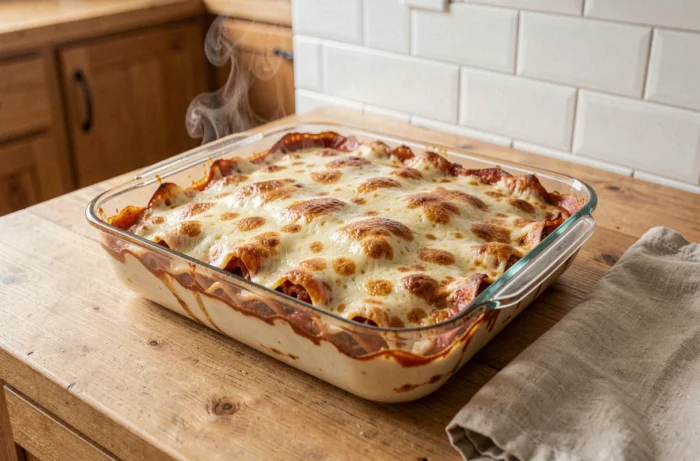
Reheating lasagna without drying it out relies on a balance of temperature, humidity, and time. Each reheating method produces a different result depending on whether it favors dry heat, steam, or rapid convection. Comparing these parameters allows you to choose the technique best suited to the desired texture.
Comparison of methods for reheating lasagna: oven, microwave, and air fryer
The choice of appliance directly determines the risk of drying out. Here is a summary of the three main techniques, along with their parameters and limitations.
| Method | Recommended Temperature | Average Duration (refrigerated portion) | Risk of Drying Out | Texture Achieved |
|---|---|---|---|---|
| Traditional Oven | Moderate (around 180 °C) | About 45 minutes | Low if covered with aluminum foil | Melting, close to the original dish |
| Microwave | Medium power | Several minutes per portion | High without cover or added water | Soft in the center, sometimes rubbery on the surface |
| Air Fryer | Moderate | Less than ten minutes | Medium, crispy top quickly | Crispy on the surface, melting inside |
The oven remains the most reliable method for achieving lasagna close to its original texture. The microwave is suitable for individual portions in a hurry. The air fryer, increasingly used, offers an interesting compromise between speed and crust quality.
Before detailing each approach, it should be noted that it is possible to easily reheat lasagna by adapting a few simple steps to each appliance.
Reheating in the Oven: The Role of Aluminum Foil and Humidity
The oven produces enveloping heat that warms the lasagna evenly. The main enemy remains evaporation: the béchamel and tomato sauce lose their moisture, the pasta hardens, and the cheese burns on the surface.
Covering the Dish to Trap Steam
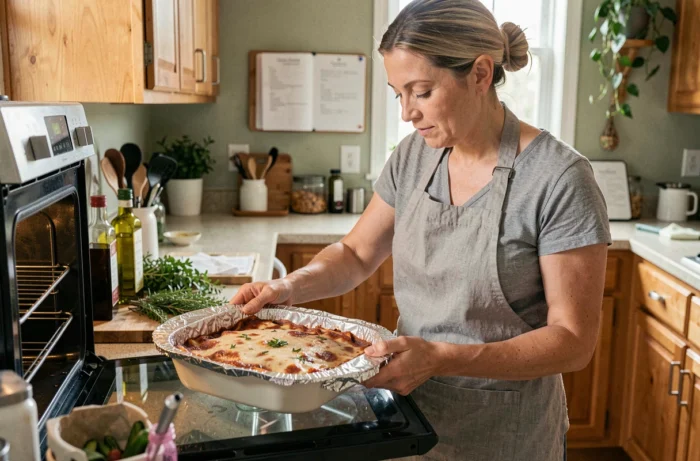
Aluminum foil limits the evaporation of the sauce and béchamel. By covering the dish before placing it in the oven, the steam remains trapped and keeps the upper layers hydrated. A few minutes before the end, removing the foil allows the cheese to brown without the rest of the dish having time to dry out.
For lasagna taken from the refrigerator, a duration of about 45 minutes at moderate temperature is generally sufficient. For frozen lasagna, the reheating time increases significantly, often up to an hour and a half.
Adding a Splash of Water or Sauce Before Baking
Pouring one or two tablespoons of water, broth, or tomato sauce over the lasagna before covering compensates for the moisture loss due to refrigeration. This simple step prevents the pasta from becoming cardboard-like. The water evaporates during cooking and creates a steam micro-environment under the aluminum foil.
Microwave: Settings to Avoid Rubberiness
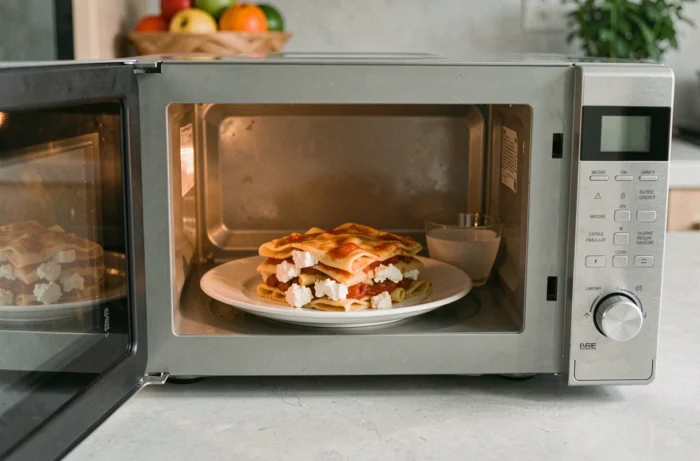
The microwave heats by agitating water molecules. The most humid areas (sauce, béchamel) heat up quickly, while the pasta and cheese react differently. The result: a burning center and edges that are still warm, or the opposite.
- Using medium power instead of maximum slows down the temperature rise and allows for more even heat distribution throughout the portion.
- Covering the portion with an inverted plate, a suitable lid, or a film with a few holes retains steam while allowing pressure to escape.
- Adding a teaspoon of water next to the portion (in the container, not on top) generates additional steam that protects the surface.
- Letting it rest for one to two minutes after reheating allows the heat to distribute towards the center of the portion, often still warm when taken out.
Turning the dish or stirring halfway through cooking compensates for the cold spots that any microwave naturally produces. This step takes a few seconds and significantly changes the final result.
Air Fryer and Lasagna: A Quick Method to Master
The air fryer works by rapidly circulating hot air. Lasagna reheats faster than in a traditional oven, with a top that becomes crispy in just a few minutes. This speed is both the advantage and the trap of the appliance.
At moderate temperature, a refrigerated individual portion reaches a satisfactory temperature in less than ten minutes. The surface becomes crispy while the inside remains melting, a result difficult to achieve in the microwave.
However, the size of the basket limits this method to individual portions or small dishes. Reheating a large family dish in a standard air fryer requires patience, with several successive batches.
Avoiding Drying Out in the Air Fryer
The flow of hot air quickly dries out the surface. Covering the portion with aluminum foil during the first few minutes, then removing it at the end of the cycle, replicates the logic of the traditional oven in an accelerated version. A slight addition of water or sauce before reheating enhances the protection.
Food Safety: Reheat Only Once
Food safety recommendations emphasize a often overlooked point: lasagna should only be reheated once. Each cycle of reheating and then cooling promotes bacterial growth in a dish rich in proteins and dairy products.
The best practice is to take only the portion to be consumed, reheat it properly, and leave the rest in the refrigerator. The center of the portion must reach 75 °C to ensure the elimination of pathogenic bacteria.
This point changes the way leftovers are stored: portioning lasagna into individual servings right after the initial meal makes subsequent reheating easier and avoids subjecting the entire dish to repeated temperature variations.
Ultimately, the choice of method depends on the time available and the quantity to be reheated. The oven remains the most reliable for a whole dish, the microwave the fastest for a single serving, and the air fryer the best compromise for achieving a gratin crust on an individual portion. In all cases, covering the dish and adding a bit of moisture before reheating are the two steps that make the difference between melting lasagna and cardboard-like pasta.