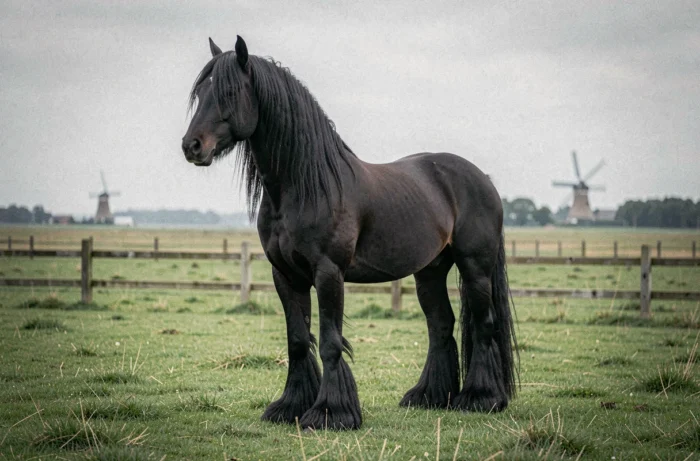
The Friesian is often presented as a black horse with a royal bearing, appreciated for its spectacular gaits. Behind this image, the breed is based on one of the strictest selection systems in the equine world: a closed stud-book, precise morphological criteria, and genetic management that directly influences the future of each lineage.
Comparing what the Friesian shares with other black breeds and what distinguishes it helps to better understand why this breed occupies a unique place.
Friesian Compared to Other Black Breeds: Morphology and Selection
| Criterion | Friesian | Mérens | Black Shire |
|---|---|---|---|
| Origin | Friesland, Netherlands | Pyrenees, France | England |
| Average Height | 1.55 m to 1.65 m | 1.45 m to 1.55 m | Over 1.70 m |
| Weight | 600 to 800 kg | Lighter | Significantly heavier |
| Coat | Solid black (very limited white markings) | Black, sometimes bay | Black, bay, gray |
| Stud-book | Closed (KFPS) | Open under conditions | Open |
| Main Disciplines | Dressage, driving, shows | Leisure, trekking, pack | Heavy driving, demonstration |
This table highlights a rarely detailed point: the Friesian is not simply a black horse among others. Its selection is based on a closed stud-book managed by the KFPS, meaning that no outside blood is allowed. In contrast, the Mérens or the Shire accept controlled crossings to broaden their genetic base.
To learn everything about the Friesian black horse breed, one must first grasp this peculiarity: the closure of the genealogical book shapes both the beauty of the breed and its vulnerabilities.
KFPS Stud-book and Genetic Management of the Friesian
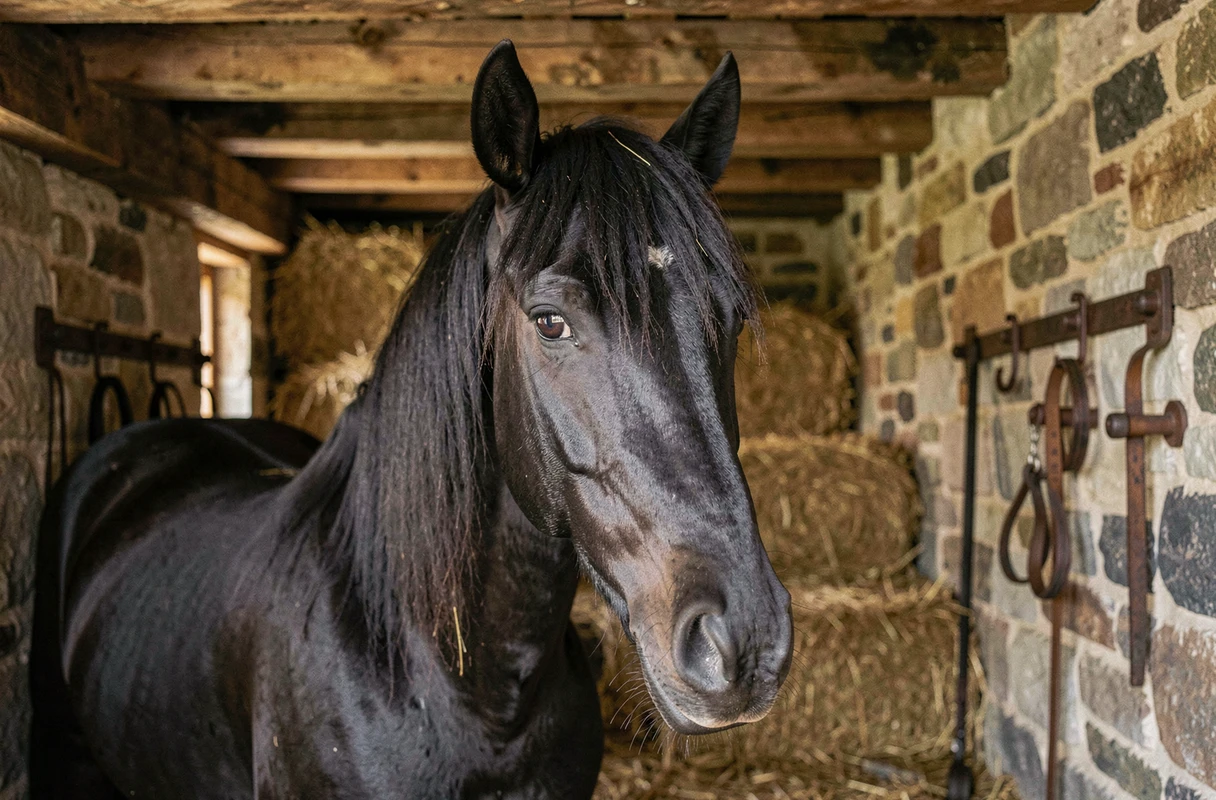
The KFPS (Koninklijke Vereniging het Friesch Paarden-Stamboek) administers the registration of all Friesians worldwide. Registration requires that both parents are themselves registered, without exception. This system ensures the homogeneity of the breed, but it also creates a genetic pressure linked to a restricted breeding population.
Inbreeding and Monitored Hereditary Conditions
Selection from a limited genetic pool has direct consequences. The breed organizations now explicitly monitor inbreeding rates and hereditary conditions identified in the Friesian population. This monitoring is a major issue for the breed’s sustainability.
On the other hand, this rigor has a measurable positive effect: it maintains a remarkable morphological consistency from one individual to another. A Friesian remains recognizable at first glance, which is not always the case for breeds with an open stud-book where physical variability can be much broader.
- Solid black is the expected and selected coat, with very limited tolerance for small white markings on the face
- Abundant feathering on the limbs, a thick and wavy mane, and a full tail are part of the conformity criteria evaluated during inspections
- Character (docility, willingness to work) also plays a role in the selection criteria, not just appearance
Actual Sports Abilities of the Friesian in Dressage and Driving
The image of the Friesian in equestrian shows and cinema may give the impression of a horse performing at all levels of competition. The reality is more nuanced.
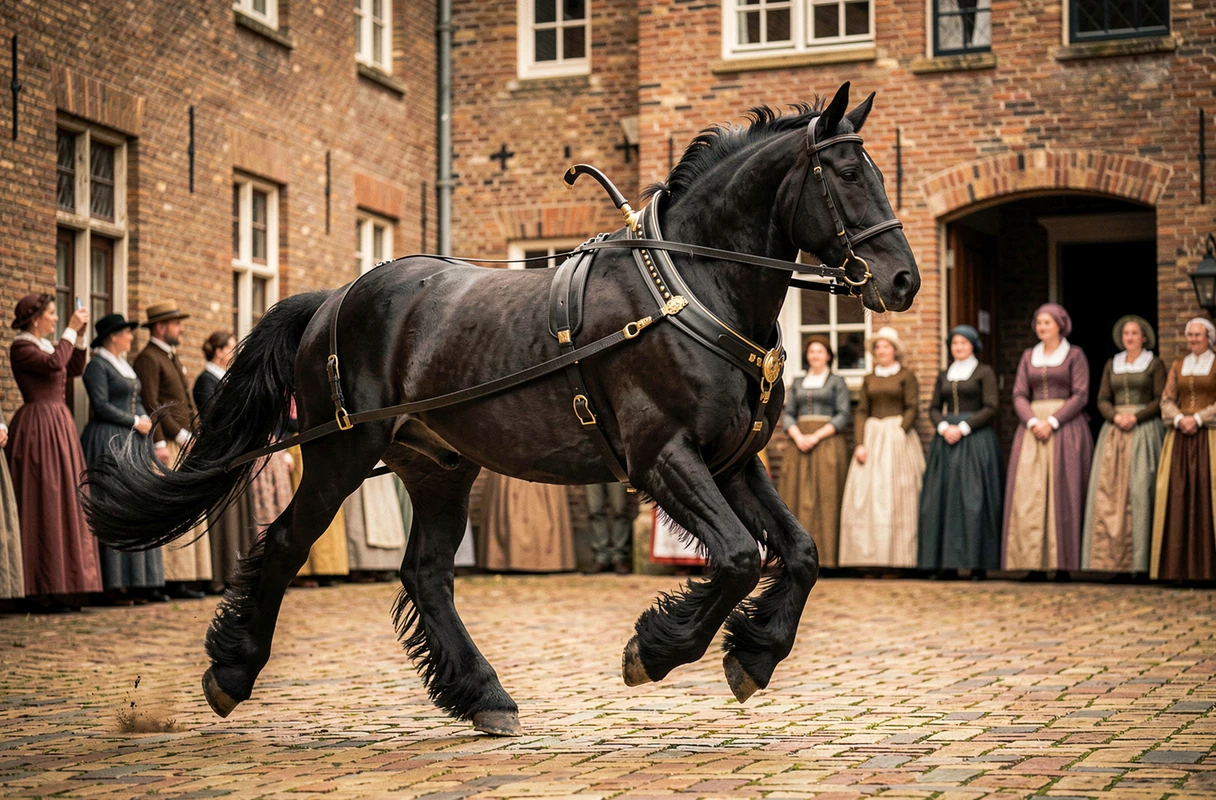
The Friesian excels in three areas: intermediate-level dressage, driving, and shows. Its elevated gaits, referred to as “baroque,” create a striking visual effect, particularly at the trot. This natural mechanics makes it very suitable for academic dressage routines and artistic presentations.
Limits in International High-Level Competition
The Friesian’s performance in international high-level competition remains more limited than its image suggests. Its morphology, heavier and more compact than that of a typical warmblood sport horse, reduces its ability to extend in the required lengthening at Grand Prix levels. In show jumping, it is almost never represented beyond the amateur level.
In driving, the situation is different. The Friesian finds a natural field of expression where its power, elegance, and ability to work in pairs or teams are fully valued. It is in this discipline that the Friesian comes closest to its utilitarian origins.
Friesian Breeding: Selection Criteria and Anticipated Budget
Acquiring a Friesian involves understanding that the price directly reflects the level of conformity to the stud-book. A horse registered with the KFPS with good evaluations (book) costs significantly more than an unassessed Friesian or one from a less selective breeding.
- Check the registration with the KFPS and the horse’s status in the stud-book (premium register, stamboek, or bijboek) before any purchase
- Request the results of available genetic tests for hereditary conditions monitored by the breed
- Anticipate a maintenance budget higher than average: the abundant feathering and mane require regular care to avoid dermatitis, and the Friesian may be sensitive to certain skin pathologies
- Prefer a breeding operation that documents the lineage over several generations and participates in official inspections
The daily care of a Friesian requires more time than for a horse with short hair. The grooming of the feathering and mane is crucial for skin health as much as for aesthetics. Neglecting this point exposes one to recurring dermatological issues, especially in a humid environment.
Choosing a Friesian is not just about its spectacular appearance. The closure of the stud-book, the issues of inbreeding, and the maintenance requirements make it a breed whose acquisition demands specific preparation. The last point to keep in mind: a Friesian conforming to the KFPS is not just a simple black horse; it is the product of a century-old selection that engages both the breeder and the owner.