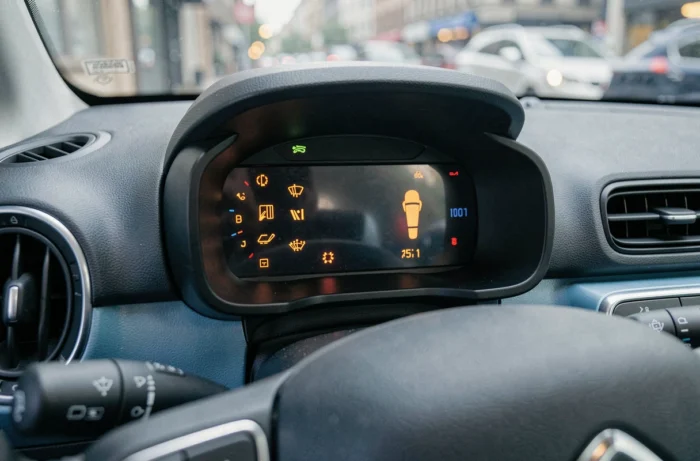
The dashboard indicators of the Citroën ë-C3 go beyond the classic alerts for temperature or oil pressure. The electric version introduces specific icons for managing the high-voltage battery, regenerative braking, and reduced power modes. Quickly identifying these symbols allows one to distinguish between simple operational information and an alert that requires stopping the vehicle.
Specific indicators for the Citroën ë-C3: what changes compared to thermal versions
General articles on C3 indicators almost exclusively cover engine, pollution, and AdBlue alerts for petrol or diesel versions. On the ë-C3, several icons simply do not exist on these engines.
The charging plug icon indicates the state of the charging: cable connected, charging in progress, or connection error. This indicator appears as soon as the vehicle is connected to a charging station or a household outlet. A charging error is usually indicated by a color change or blinking, signaling a communication problem between the onboard charger and the station.
The turtle icon signals reduced power. It activates when the high-voltage battery level becomes too low or when the propulsion system triggers thermal protection. The vehicle remains drivable, but the maximum speed and acceleration are limited. Driving in degraded mode for several kilometers without recharging increases the risk of complete breakdown.
The B mode indicator (enhanced regenerative braking) confirms the activation of a more pronounced deceleration when lifting off the accelerator. This is not an alert: it simply indicates that the driver has selected a higher energy recovery level. To better identify each symbol, a guide listing the dashboard indicators of the Citroën C3 electric with images facilitates the matching of icon and meaning.

Color code of alerts: urgency hierarchy on the ë-C3
The color logic on the latest generation C3 and ë-C3 follows a standardized hierarchy found in recent manuals. The table below summarizes the expected behavior for each level.
| Indicator Color | Urgency Level | Recommended Action |
|---|---|---|
| Red | Stop as soon as possible | Cut off the propulsion system, check the relevant level, or call for assistance |
| Orange / Yellow | Anomaly to be diagnosed | The vehicle remains drivable, but a workshop visit is necessary within a few days |
| Green / Blue | Operational information | No risk, the indicator confirms the activation of a system (lights, charging, eco mode) |
On an electric vehicle, a red indicator related to the high-voltage battery imposes an additional precaution: do not open the hood or touch the orange cables of the high-voltage circuit. Only a qualified technician should intervene.
Difference between blinking and steady light
A continuously lit orange indicator signals an anomaly recorded by the computer. The same indicator that blinks often indicates an active fault, for example, an ignition misfire on a thermal engine or, on the ë-C3, an interruption of ongoing charging. A rapid blink warrants quicker attention than a steady light.
Indicators shared between electric and thermal versions: reading pitfalls
Several symbols are visually identical on thermal C3s and the ë-C3, but their meanings differ depending on the engine type.
- The classic battery indicator (rectangle with +/- terminals) signals a fault in the 12 V charging circuit on both versions. On the ë-C3, it does not concern the high-voltage traction battery, but only the small auxiliary battery that powers the onboard electronics.
- The temperature indicator does not monitor a thermal engine on the ë-C3: it can signal overheating of the battery pack or electric motor, two situations that trigger turtle mode before reaching a critical threshold.
- The ESP/ASR indicator functions identically on both platforms. Its steady light indicates a deactivation or fault in stability control, while its blinking confirms an active intervention by the system on a slipping wheel.
Onboard diagnostics and limitations of self-diagnosis on the ë-C3
The ë-C3 uses a CAN communication network between its computers. When an orange indicator lights up, a fault code is stored in the memory of the relevant computer. Reading this code requires a compatible diagnostic tool, often the proprietary Citroën software or a recent multi-brand tool that supports electric vehicle protocols.
Clearing an indicator without reading the fault code is akin to masking the symptom. On forums, the practice of disconnecting the 12 V battery to reset alerts is frequently discussed. On the ë-C3, this operation can disrupt the high-voltage battery management system and cause a lengthy recalibration upon restart.
When a workshop visit is necessary
Three situations justify a quick appointment rather than an attempt at self-resolution:
- A red indicator accompanied by a text message on the central screen requesting the vehicle to stop.
- The turtle icon activating while the displayed charge level remains above a quarter, which may indicate a cell fault in the battery pack.
- A repeated charging error on several different stations, pointing to a problem with the onboard charger rather than the external infrastructure.
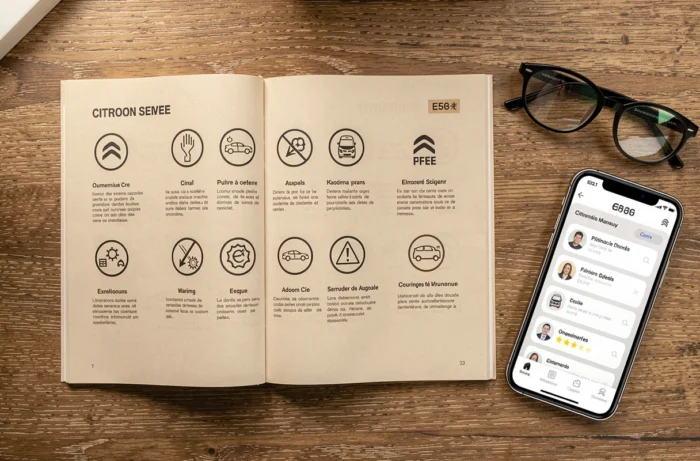
The distinction between an informative indicator and an alert indicator relies on color, behavior (steady or blinking), and any message on the screen. On the ë-C3, the icons related to electric propulsion add a layer of interpretation absent in thermal versions. Keeping the manual in the glove compartment remains the most reliable reflex to clarify doubts in a matter of seconds.