
The PDF file sent to the printer alone determines the quality of the finished book. Before choosing a cover format or binding type, we recommend locking in the technical preparation of the document, where most costly errors occur.
Color Profile and PDF Resolution for Book Printing
A PDF intended for screen (sRGB, 72 dpi) is not suitable for printing. The file must be exported in CMYK with an ISO Coated v2 profile to ensure color fidelity on digital presses. Any image embedded in the document requires a minimum sufficient resolution to avoid visible blurriness, especially on covers and full-page illustrations.
Embedding fonts in the PDF is often a neglected point. If the fonts are not embedded, the printer substitutes a default font, which shifts the layout, alters pagination, and can create text overflow. We regularly observe this problem with files generated from mainstream word processors.
It is possible to print a book online with Blogueuse Entrepreneuse by following a clear methodology that covers these technical prerequisites, from format selection to final export.
Bleeds and Inner Margins
Bleeds (the area that extends beyond the trim line) must be set up in the layout software before export. Without this safety margin, trimming can reveal a white edge on the pages containing images or solid colors.
The inner margin (binding side) requires special attention. For a perfect bound book, this margin should be more generous than the outer margin to compensate for the limited opening of the block. Text placed too close to the fold becomes unreadable once the book exceeds a hundred pages.
Paper and Binding Choices Based on Book Type
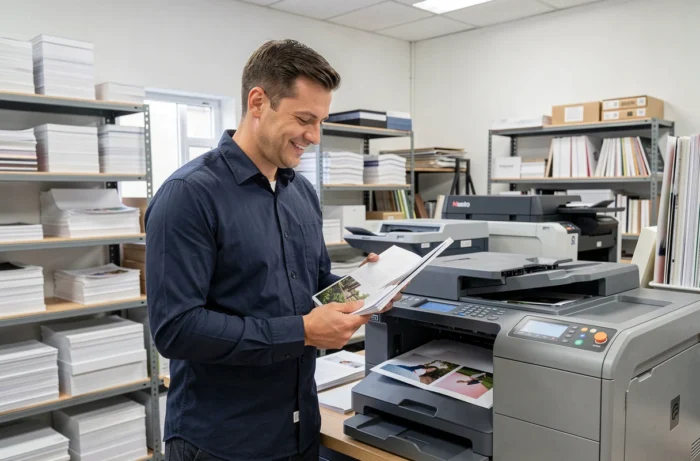
The weight of the interior paper directly influences the appearance and unit cost. Paper that is too thin allows the printed text on the back to show through, while paper that is too thick bulks up the spine and increases shipping costs. For a novel or narrative, an ivory offset paper in standard weight offers optimal reading comfort. For a photo book or portfolio, a matte or glossy coated paper better reproduces colors.
The binding determines the durability and use of the book:
- The perfect binding is suitable for most works of more than fifty pages, offering good value for money in print-on-demand.
- Spiral binding (or Wire-O) works for practical guides, recipe books, or manuals that need to lie flat.
- Hardcover binding positions the book as a premium item but significantly increases the unit cost and production time.
Coating the cover (matte, glossy, or soft touch) protects the book and alters its tactile perception. A matte coating gives a sober appearance, while a glossy finish enhances the color contrast on the front cover.
Print on Demand and Often Overlooked Legal Obligations
Print on demand allows for the production of a book from a single copy, without initial stock. This model relies on digital printing, which does not require offset plates. The unit cost remains stable regardless of the number of copies ordered, unlike offset printing where the price decreases significantly with volume.
As soon as a book is distributed beyond the family circle, the self-published author is legally considered a publisher. This qualification entails a legal deposit obligation with the BnF, with no minimum print run threshold. Publishing a single copy for sale on an online platform is enough to trigger this obligation.
Graphic Paper REP System from 2024
Since January 1, 2024, the REP (extended producer responsibility) system includes printed materials, including books, within the scope of household packaging. Specifically, any person or entity placing printed materials on the market must register with an approved eco-organization. This eco-contribution applies even to self-published authors who sell their works.
Most print-on-demand platforms handle this declaration on behalf of the author, but we recommend checking this point before finalizing an order.

Spine Calculation and Verification Before Sending the PDF File
The thickness of the spine depends on the number of pages and the weight of the chosen paper. An incorrectly calculated spine causes a misalignment of the cover on the finished book: title text off-center, back cover visual cropped. Most online printers provide a spine calculator or a template to download. Using this template avoids back-and-forth file exchanges and reprints.
Before the final submission, a verification checklist helps limit unpleasant surprises:
- Check that the PDF file is in CMYK mode with embedded fonts.
- Verify the bleeds on each page containing a border visual.
- Proofread the cover (title, author name, ISBN if applicable) on the template provided by the printer.
- Order a validation copy before launching a larger print run.
The validation copy (often called “proof” or “good to print”) remains the best guarantee. The screen does not accurately reproduce the paper rendering, and some defects (paper transparency, spine alignment, rendering of dark photos) can only be detected in hand.
Mastering these technical steps transforms a simple online order into a book whose quality rivals that of traditional publishing production. The rest, format, number of pages, print run, is a personal decision that each author adjusts to their project.