
The women’s and children’s fashion market is going through a period of tension between the accelerated renewal of collections and the rising demands for sustainability. In France, the National Assembly dedicated a session on June 24, 2026, to the issue of ultra-fast fashion and its effects on the textile sector. This political signal changes the game for both brands and consumers, prompting a reconsideration of what “trend” really means this season.
Upcycled fashion and textile transparency: what changes shopping
Sustainability is no longer just a logo on a label. The segment of upcycled fashion is experiencing growth driven by a demand for transparency regarding the origin and composition of clothing. Buyers want to know where the fabric comes from, how it was dyed, and whether the piece can last several seasons.
This “less but better” movement is restructuring the market. Brands that publish the traceability of their fibers attract customers willing to pay more for a piece whose production they understand. In contrast, brands that multiply micro-collections without justifying their supply chain lose credibility.
For mothers dressing both their children and themselves, this logic has a concrete effect: fashion trends on Maman Modeuse are centered around mixable and durable pieces, rather than disposable looks renewed every month.
Natural materials for children: linen, organic cotton, and safety requirements
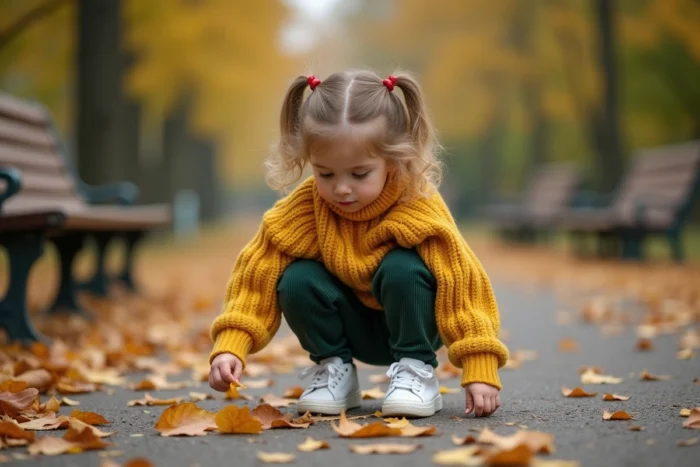
Natural fibers dominate children’s collections this season. Linen and organic cotton are back in most ranges, with palettes focused on earthy tones (sand, olive, misty gray) and pastels like lavender.
Competitors focus on aesthetics. They describe colors, silhouettes, and prints. The angle they neglect is the safety of children’s clothing and accessories. Parental feedback shows that selection criteria go beyond style: compliance with European standards, absence of small detachable parts on toddlers’ clothing, and dyes certified free from harmful substances.
The European standard EN 1888, for example, concerns strollers but illustrates a broader mindset. Parents who buy childcare equipment with five-point harness requirements and car seat compatibility apply the same rigor to their wardrobe. A poorly sewn button on a baby’s overalls is not an aesthetic detail; it’s a choking hazard.
Concrete criteria for choosing durable and safe children’s clothing
- Check the certification of dyes (Oeko-Tex label or equivalent mentioned on the label) to limit exposure to allergenic substances
- Prefer snap closures over buttons on pieces intended for children under three years old to reduce the risk of ingestion
- Choose cuts that allow layering without restricting movement, extending the use over several seasons
Women’s fashion trends: the return of structured cuts and heirloom pieces
On the women’s side, the season is marked by a decline in oversized silhouettes in favor of more fitted and structured cuts. Denim bermuda shorts and white shirts are returning to wardrobes, but with a different approach: the focus is on pieces that will last through several summers rather than looks for a single outing.
Bold prints remain present, especially floral patterns and color-blocking. However, the most significant trend is not about a pattern or a color. It concerns the way of buying. Customer experiences and on-the-ground reviews weigh more than advertising campaigns in the purchasing decision.
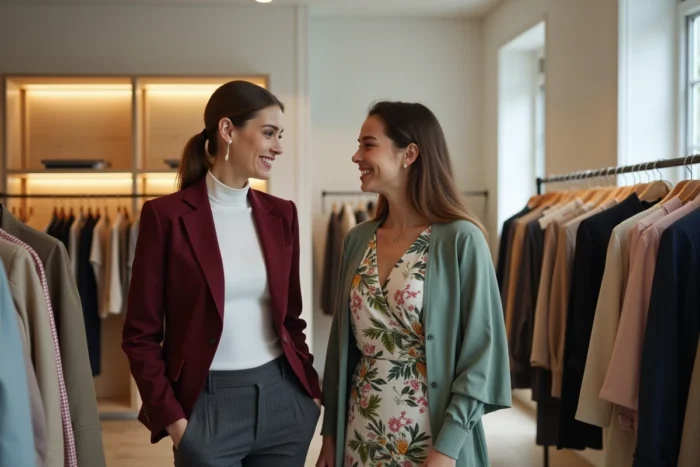
Resale platforms and clothing swaps among mothers fuel a parallel circuit where quality pieces circulate multiple times. A well-cut linen jacket bought two seasons ago can be resold easily if the brand is identifiable and the material intact. This phenomenon encourages buyers to think in terms of “resale value” from the initial purchase.
Political debate on fast fashion: what it changes for families
The National Assembly session on June 24, 2026, dedicated to ultra-fast fashion is not trivial. It takes place in a context where the accelerated renewal of collections is explicitly questioned by institutions.
For families, the possible consequences are direct. If regulatory measures come to frame the frequency of market launches or impose strengthened transparency obligations, the price of low-cost clothing could increase. The available data does not allow for conclusions about the timing or exact form of these measures, but the direction is clear.
This context reinforces the logic of investing in versatile pieces. A coordinated children’s outfit in organic cotton, worn with interchangeable accessories, costs more at the unit purchase but is cheaper in the long run if kept for two seasons. The same reasoning applies to women’s basics: a well-cut pair of jeans, a shirt made from natural materials, repairable shoes.
Versatile pieces to prioritize this season
- Linen or thick cotton shirt, wearable open over a t-shirt or closed as a main piece, for women and children from six years old
- Neutral-colored cargo or chino pants (sand, khaki, gray), mixable with any top and durable enough for outdoor play
- Straight dress without a zipper for girls and women, adaptable with a belt or cardigan depending on the temperature
- White sneakers made of leather or thick canvas, repairable by a cobbler, suitable for both city and nature outings
This season’s fashion boils down to a trade-off that each family makes differently: renew often at a low price or invest in pieces that last. The ongoing political debate and the rise of upcycling push the cursor toward the latter option, but budget constraints remain real.
Buying less only works if what you buy lives up to its quality promises. The question remains the same: read the label before looking at the price.