
A dripping faucet, an overflowing shelf, a room where one no longer feels comfortable: these small daily signals often reflect a mismatch between the layout of the home and how one actually lives in it. Before seeking spectacular solutions, a few targeted adjustments in maintenance and organization are enough to transform the atmosphere of an interior.
Indoor air quality: cleaning is not enough
Have you ever noticed a lingering smell after cleaning the bathroom with a scented spray? This is not a sign of cleanliness. Strongly scented products release compounds that remain suspended in the air, sometimes for several hours after cleaning.
Daily ventilation, especially after each cleaning session, remains the most effective gesture to limit the accumulation of contaminants. Opening the windows for a few minutes creates a draft that removes these residues much better than any air freshener.
Ventilating after cleaning reduces the concentration of pollutants in indoor air. It’s a simple reflex, but few maintenance guides mention it as a priority. For those who wish to delve deeper into the topic of healthy living and room-by-room layout, it is possible to consult simplyhabitat.fr for the home and find additional resources there.
The choice of cleaning products also plays a direct role. A fragrance-free detergent, baking soda, or black soap covers most everyday cleaning needs without degrading air quality. The goal is not to ban all industrial products but to reserve the most aggressive formulas for tasks that truly justify them, such as occasional descaling.
Zone-based storage: adapting furniture to what it contains
Most storage advice revolves around sorting. Sorting is useful, but the real lever lies upstream: each piece of furniture should correspond to the shape and frequency of use of the items it holds.
Take the kitchen, for example. A deep drawer filled with loose utensils quickly becomes unusable. Adjustable dividers, even basic ones, transform this drawer into a functional space. The same principle applies to an entry closet: if you store shoes, scarves, and umbrellas there, a single type of shelf will not suffice.
Some guidelines for organizing technical spaces
- In the bathroom, prefer closed storage for clean laundry and airy baskets for dirty laundry to avoid stagnant moisture
- In the kitchen, store everyday utensils between hip and shoulder height to limit unnecessary movements
- In the entryway, provide a catch-all or a hook at child height if the family includes children, so everyone can manage their belongings without help
The idea is not to buy new furniture. Reorganizing the insides of existing furniture often produces a more visible result than a purchase. A simple fabric bin in an open shelf changes the perception of order in an entire room.
Surface maintenance: adapting the product to the material
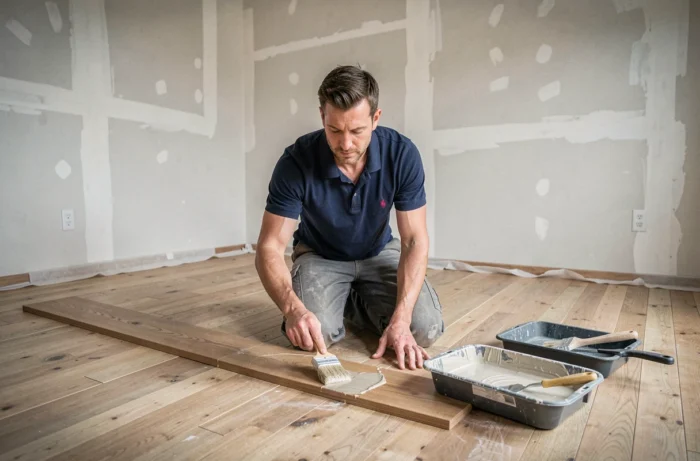
A tiled floor, a varnished parquet, and a laminate countertop do not react the same way to the same cleaner. Applying an acidic product on marble, for example, damages it irreversibly. This type of mistake is common, as multi-purpose cleaners give the impression of being suitable everywhere.
A neutral product (pH close to 7) is suitable for most common surfaces. White vinegar, often recommended for everything, should actually be avoided on natural stone, silicone joints, and certain varnished coatings. Its ideal use remains for occasional descaling of faucets and stainless steel sinks.
Cleaning frequency by room
The kitchen and bathroom concentrate moisture, grease, and organic residues. A quick pass after each use (wiping the countertop, scraping the shower wall) prevents deep soiling. The living room and bedrooms mainly require regular dusting and a slow vacuuming, focusing on textiles (carpets, curtains) that trap allergens.
Why emphasize the slowness of vacuuming? A too-quick motion does not allow the suction to capture fine particles embedded in the fibers. Slowing down the action, without changing the device, significantly improves the result.
Small routine maintenance tasks: anticipate rather than repair
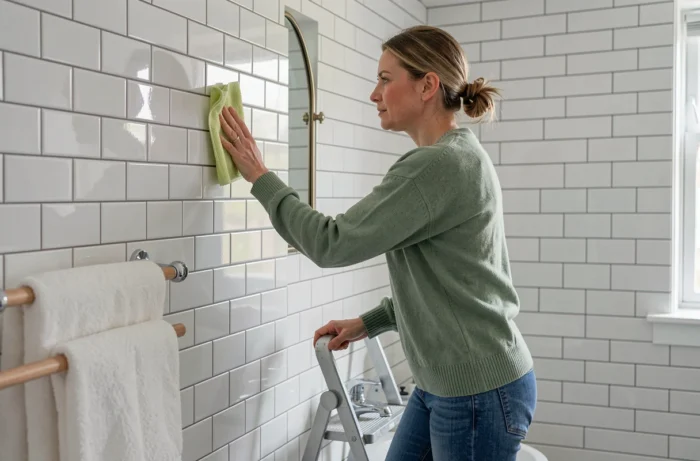
A blackened bathroom seal, a squeaky door hinge, a clogged extractor hood filter: these micro-defects gradually settle in and end up degrading comfort without one realizing it. Addressing them as they arise takes just a few minutes. Allowing them to accumulate turns a Saturday into a marathon of repairs.
- Check the silicone seals around the shower and sink once per season, and replace them as soon as they blacken or detach
- Clean the ventilation and extractor hood filters every three months to maintain sufficient airflow
- Lubricate hinges and locks once or twice a year with an appropriate lubricant, not cooking oil
- Bleed radiators before each heating season to eliminate trapped air that reduces their efficiency
Maintaining ventilation prevents humidity and mold problems. Since the beginning of 2025, the obligations for evaluating ventilation have been strengthened in certain public establishments, highlighting the growing attention to this issue. On the scale of a home, the principle remains the same: a clogged ventilation system no longer fulfills its function.
Anticipating small repairs costs less than facing major ones. A seal costing a few euros replaced in time can prevent water infiltration that damages furniture or flooring. This preventive logic also applies to the garden, where cleaning gutters and maintaining fence fixtures prolong the lifespan of outdoor installations.
The layout and maintenance of a home are not just a checklist of tasks to tick off. Each action gains effectiveness when it is adapted to the material in question, calibrated in frequency, and considered an investment of a few minutes rather than a postponed chore. The comfort of an interior depends less on its size than on the attention given to the details that compose it.